 中文
中文
 English


brake blocks - Performance Assessment on AC Locomotives
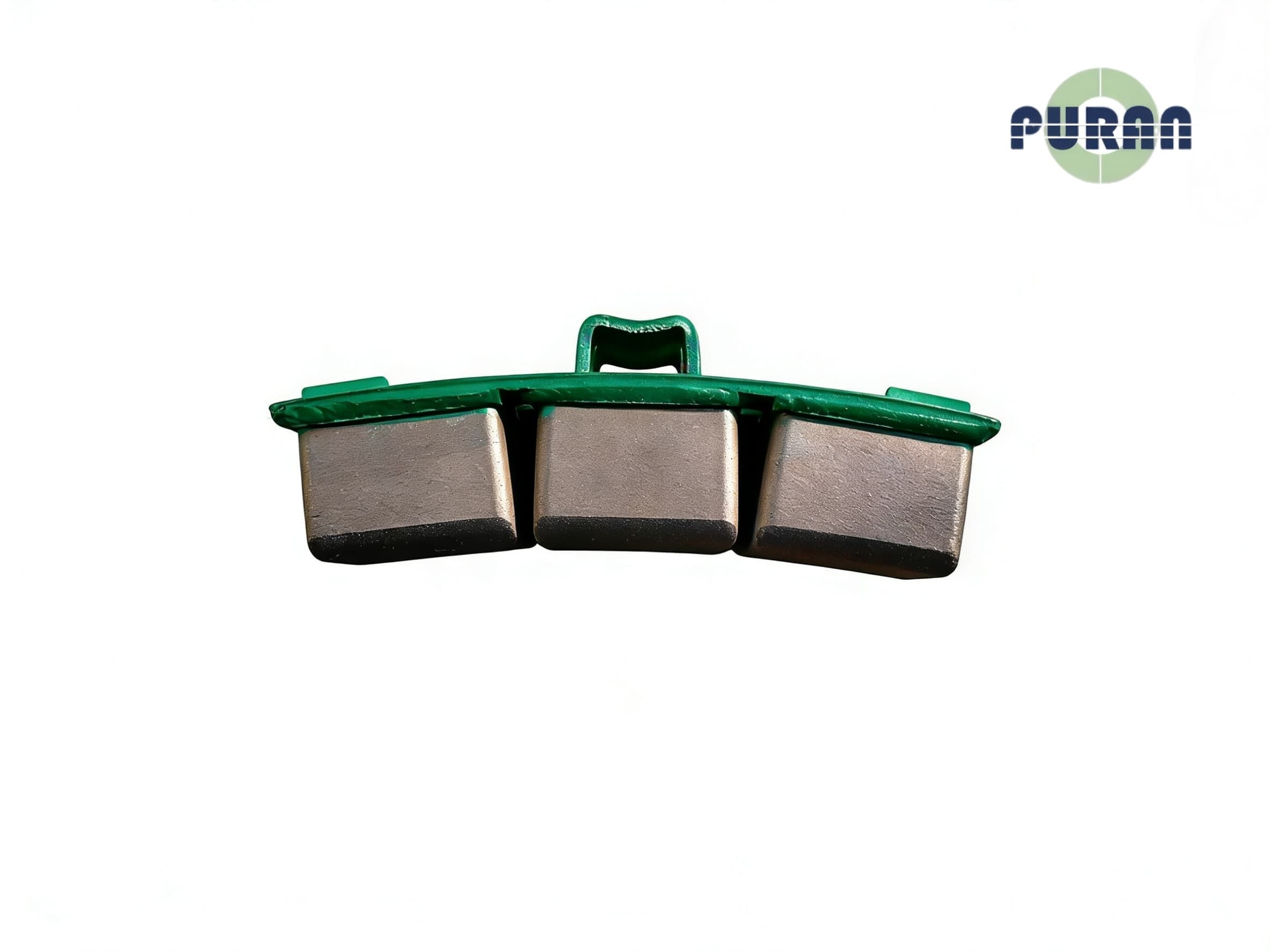
In heavy-haul freight and high-speed rail transportation, modern alternating current (AC) drive electric locomotives exert extreme thermomechanical demands on mechanical braking systems. Traditional resin-based synthetic brake shoes frequently experience thermal fading, accelerated wear, and material degradation when subjected to continuous drag braking or high-speed stop braking exceeding 520°C. To address these operational challenges, powder metallurgy technology—specifically copper-based friction matrices—has emerged as the premier solution for heavy-duty locomotive friction management.
This technical article presents empirical evaluation data for the M1 powder metallurgy brake shoe, developed specifically for CRRC high-power AC electric locomotives. The comprehensive performance evaluation combines 1:1 full-scale dynamometer testing conducted at CNAS-accredited facilities (Test Reports (2022)DL-R0058 & (2022)GTJ(JH)-R1444) alongside extensive field endurance trials.
locomotive fitness
The M1 powder metallurgy brake shoe (Drawing No. PRFZW160A-00-000) was engineered specifically to match the wheel-rail force profiles, bogie kinematics, and thermal dissipating capacity of CRRC's mainline AC drive electric locomotive fleet. Table 1 summarizes the locomotive fitness and operational parameters verified during trial runs.
| Locomotive Series | Axle Arrangement / Power | Maximum Speed | Brake Block Configuration |
|---|---|---|---|
| HXD1 / HXD1B / HXD1C | Bo'Bo' / Co'Co' (7,200 - 9,600 kW) | 120 km/h | M1 Powder Metallurgy (16 blocks/loco) |
| HXD2 / HXD2B / HXD2C | Bo'Bo' / Co'Co' (7,200 - 9,600 kW) | 120 km/h | M1 Powder Metallurgy (16 blocks/loco) |
| HXD3 / HXD3B / HXD3C | Co'Co' (7,200 - 9,600 kW) | 120 km/h | M1 Powder Metallurgy (24 blocks/loco) |
| FXD3-J (AC Freight) | Co'Co' Heavy Freight | 120 km/h | M1 Powder Metallurgy Heavy-Duty Variant |
Mechanical compatibility inspections confirm that the M1 design adheres strictly to standard locomotive brake head geometries. Standardized manufacturing tolerances and structural contours ensure seamless replacement of older synthetic blocks without any modifications to the locomotive brake rigging or cylinder force levers.
locomotive brakes
To evaluate performance under extreme operational stress, full-scale braking tests were performed on a 1:1 brake inertia dynamometer under both dry and wet environmental conditions, simulating emergency stopping, hill-descent drag braking, and high-energy thermal fatigue cycles.
Unlike conventional composite materials that experience severe friction degradation at elevated temperatures, the copper-matrix alloy in the M1 shoe maintains a stable transfer film on the wheel tread. Figure 2 presents the dynamic friction coefficient (μ) trend across varying initial braking speeds under standardized 30 kN clamping force.
| Speed (km/h) | 40 | 60 | 80 | 100 | 120 |
|---|---|---|---|---|---|
| M1 Powder Metallurgy Block | 0.292 | 0.278 | 0.258 | 0.232 | 0.215 |
| Legacy Composite Shoe | 0.275 | 0.240 | 0.200 | 0.165 | 0.140 |
The empirical data demonstrates that while synthetic brake shoes suffer significant friction degradation at speeds above 80 km/h due to thermal softening of resin binders, the M1 powder metallurgy shoe maintains a highly predictable friction profile (μ = 0.292 at 40 km/h to μ = 0.215 at 120 km/h). This stability significantly reduces stopping distances and prevents thermal overrun during high-speed braking.
Furthermore, under continuous grade-descent simulation (constant 60 km/h drag braking at 10 kN for 10 minutes), the wheel tread interface reached peak thermal equilibrium exceeding 255°C. Despite this severe thermal load, the M1 brake shoe recorded zero structural cracking, non-uniform metal pick-up, or tread fusion. Measured wear rates remained exceptionally low at 0.178 cm³/MJ during baseline cycles and 0.312 cm³/MJ during high-load thermal stress testing.
| Testing Condition Cycle | M1 Powder Metallurgy Block | Legacy Composite Shoe | Wear Reduction |
|---|---|---|---|
| Baseline Conditions (Prog 1-45) | 0.178 cm³/MJ | 0.395 cm³/MJ | -54.9% |
| High Thermal Duty Load (Prog 83-103) | 0.312 cm³/MJ | 0.588 cm³/MJ | -46.9% |
In addition to dry-state dynamics, wet braking evaluations (water spray applied at 15 L/h) demonstrated excellent water recovery characteristics. The mean wet friction coefficient remained well above the minimum standard requirement of 0.21, registering μ = 0.245 even at speeds of 100 km/h, effectively preventing hydroplaning or catastrophic loss of braking effort in adverse weather.
Detailed physical-mechanical property verification further confirms structural integrity across all batch samples:
- Sintered Matrix Density: Constant at 4.85 g/cm³, providing ideal balance between heat capacity and structural mass.
- Compressive & Shear Strength: High mechanical locking strength prevents shear separation at the steel backing plate junction under high impact forces.
- Static Friction Coefficient: Tested average of 0.375 (exceeding the strict ≥ 0.35 baseline requirement), providing robust holding power for locomotive parking brake applications on steep gradients.











